
Kajari Teej 2026
Kajari Teej — also called Satudi Teej, Badi Teej, or Nimbi Teej — is the second and most earthily rooted of the three major Teej festivals. It falls on the third day (Tritiya) of the dark fortnight (Krishna Paksha) of Bhadrapada, approximately 16 days after Hariyali Teej. In 2026, it falls on Monday, August 31. What makes Kajari Teej unique is the worship of Goddess Parvati in the form of Nimbi Mata (the divine mother residing in the Neem tree) and the rich tradition of Kajari folk songs — one of the most ancient musical traditions of North India.
Kajari Teej 2026 — Exact Tithi & Muhurat
The Bhadrapada Krishna Tritiya Tithi and the auspicious puja window (IST):
⭐ The Special Significance of the Evening Celebration
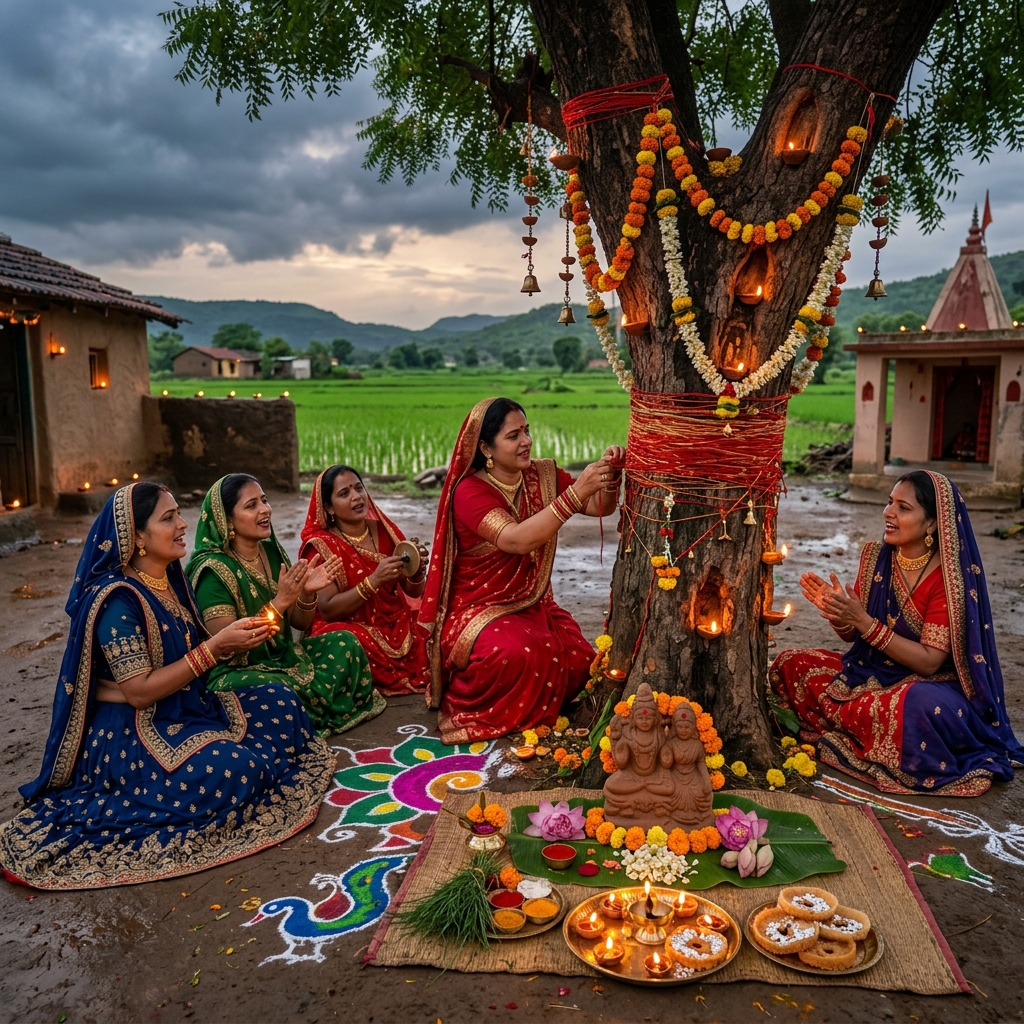
Unlike Hariyali Teej (which centers on the morning puja), Kajari Teej has dual celebration windows: the early morning (06:00–08:30 AM) for the Gauri-Shiva puja and Neem tree worship, and the evening twilight (Sandhya Kaal — 6:30–8:00 PM) for the community Kajari singing session (Kajari Mehfil). The evening gathering is uniquely important to Kajari Teej — women and folk musicians gather under Neem or Peepal trees to sing Kajari songs collectively, and this communal musical devotion is itself considered a form of puja. The fast is broken the next morning (September 1) after the morning puja — not at moonrise, making Kajari Teej fast one of the longest Teej fasts.
The Deep Significance of Kajari Teej
Why Kajari Teej is the most ecologically wise and musically rich of all three Teej festivals.
Nimbi Mata — Parvati in the Neem
On Kajari Teej, Goddess Parvati is worshipped in her earthly form as Nimbi Mata — the divine mother who resides in the Neem tree (Nimba in Sanskrit). This form of worship predates the Vedic period and represents the oldest, most elemental layer of Parvati worship — the forest goddess, the tree mother, the earth protector. The Skanda Purana mentions that Parvati, pleased by the women's devotion on Bhadra Krishna Tritiya, manifests in the Neem tree to grant blessings. Tying a red thread around the Neem and circling it seven times (Pradakshina) is the central ritual of Kajari Teej.
Kajari — The Ancient Monsoon Raag
Kajari is one of the oldest folk music traditions of North India, originating in the Mirzapur-Varanasi belt of Uttar Pradesh and Bihar. It is a monsoon genre, like Malhar, but rooted in village life rather than classical music. The word Kajari is believed to derive from Kaajal (kohl/eyeliner) — referring to the dark monsoon clouds that look like kajal-painted eyes, or from Kaaj (black), referencing the dark color of the rain clouds. Legends like Girija Devi, Siddheshwari Devi, Rasoolan Bai, and Ustad Bismillah Khan have celebrated Kajari as one of India's finest folk art traditions.
The Harvest Blessing Connection
Kajari Teej falls at the height of the Kharif (monsoon) crop season — when rice, sugarcane, maize, and cotton fields are lush and green after weeks of rain. Sattu (roasted gram flour) — the definitive Kajari Teej Prasad — is the food of the farming community, packed with protein for those working in monsoon fields. The festival is as much a harvest thanksgiving as it is a women's Vrat — communities pray to Parvati (as the earth mother) for a successful, bountiful Kharif harvest. The Kajari songs themselves are filled with imagery of planting seeds, the smell of wet earth, and the joy of growing crops.
The 3 Major Teej Festivals — Side by Side
Understand how Kajari Teej is distinct from Hariyali Teej and Hartalika Teej.
Hariyali Teej
Kajari Teej (Satudi Teej)
Hartalika Teej
The Sacred Neem Tree — Nimbi Mata Explained
Why the Neem tree is the centre of Kajari Teej — from mythology to Ayurveda.
Parvati as Nimbi Mata
In the Kajari Teej tradition of UP and Bihar, Goddess Parvati is specifically worshipped in the form of Nimbi Mata — the divine mother who resides in the Neem tree. The Neem tree is considered Parvati's earthly home during the Bhadra month. Tying sacred threads to the Neem, circling it, and singing to it are all acts of directly communicating with the Goddess.
Neem's Sacred Healing Power
Neem (Azadirachta indica) is called the "village pharmacy" in Ayurveda — it purifies blood, fights infection, protects crops, and was used as a natural toothbrush (Datun) for centuries. Worshipping it during the monsoon season (when infections peak) is a brilliant integration of ecological wisdom with spiritual practice — the divine protection of Parvati manifests through Neem's real medicinal properties.
Monsoon Timing — Maximum Potency
Neem trees bloom most powerfully during the monsoon. The Bhadra month (when Kajari Teej falls) is when Neem's medicinal compounds are most concentrated in the bark and leaves. Ancient communities knew that circling the Neem tree, breathing its air, and touching its bark during this season was maximally beneficial. The spiritual tradition preserves this ecological knowledge through ritual.
The Sacred Red Thread (Nimbi Dhaga)
Women tie a sacred red thread (Nimbi Dhaga or Mauli) around the Neem tree trunk while circumambulating it (Pradakshina) seven times. Each circle is accompanied by a prayer for the husband's health and the household's protection. The thread symbolizes the bond of marriage — as strong and enduring as the ancient Neem tree. The thread remains tied for the entire year.
Neem Offerings in the Puja
Fresh Neem leaves and bark are offered in the Kajari Teej puja Thali alongside flowers. Neem leaves are placed around the clay Parvati-Shiva idol. Neem-infused water is used for the Abhishek of the idol. In some traditions, the Prasad includes small amounts of Neem for its cleansing and healing properties.
9 Types of Kajari Songs — India's Monsoon Folk Treasure
Kajari is one of the most ancient folk music traditions of North India. Explore its different forms — from village simplicity to classical grandeur.
Sawan Ki Kajari
Mood: Monsoon longingThe classic rain-season Kajari — a woman longs for her husband away in the city while the monsoon clouds thunder. The lyrics describe dark clouds, wet earth, the call of the Papeeha bird, and the ache of separation (Viraha). The most emotionally raw of all Kajari genres.
Step-by-Step Kajari Teej Puja Vidhi
Kajari Teej has two main puja windows: the morning Gauri-Shiva puja (06:00–08:30 AM) and the evening Neem tree worship & Kajari songs (6:30–8:00 PM) on August 31, 2026.
- 1
Pre-Dawn Snanam & Sankalpa
Wake before sunrise. Take a purifying bath — traditionally with Neem-leaf-infused water or sesame oil. Wear clean attire, ideally in blue, indigo, or dark red (the colours associated with Kajari Teej). Apply fresh Sindoor and Solah Shringaar. Sit facing east and take the Vrat Sankalpa: "I observe the Kajari Teej Vrat for the long life and prosperity of my husband. May Nimbi Mata (Parvati in the Neem) bless our family with health, abundance, and eternal love."
- 2
Clay Idol Preparation — Gauri-Shiva Murti
Prepare a fresh clay idol of Goddess Parvati and Lord Shiva from river clay (Nadi ki Mitti). Place on a banana leaf altar decorated with fresh Durva grass, Neem leaves, and marigolds. In Kajari Teej tradition, the clay idol is freshly made each year — this hand-crafted idol carries the devotee's own energy and is considered far more meritorious than a purchased brass idol for this particular festival.
- 3
Gauri-Shiva Morning Puja — 16 Services
Perform the Shodasopachara Puja (16 services) to the clay Parvati-Shiva idol: bath with Panchamrit, dress with new cloth, offer marigold garlands, Neem leaves, jasmine, Bilva patra (for Shiva), sandalwood paste, incense, ghee lamp, and Naivedyam (Sattu Prasad, Ghevar, fruits). Ring the bell throughout and chant Parvati and Shiva mantras. Perform the Aarti at the end with camphor.
- 4
Kajari Teej Vrat Katha Shravan
Read or listen to the Kajari Teej Vrat Katha — the story of Parvati's austerities and the specific circumstances under which she took shelter in a Neem tree and was discovered by Shiva. This Katha is found in regional versions of the Skanda Purana and Bhavishya Purana. The Katha must be heard before proceeding to the Neem tree worship. Distribute Sattu Prasad to everyone present after the Katha.
- 5
Nimbi Mata Puja — Neem Tree Worship (Core Ritual)
Visit the nearest Neem tree (preferably in the morning or at twilight). Decorate it with marigold garlands and fresh flowers. Light a clay diya at the base of the tree. Apply turmeric and kumkum to the bark. Pour pure water or Panchamrit at the roots. Then tie the sacred red Nimbi Dhaga (Mauli thread) around the trunk while circumambulating (Pradakshina) the tree seven times, chanting "Om Gauryai Namah" with each circle. Offer fresh Neem leaves and flowers at the base.
- 6
Kajari Songs — Evening Community Gathering
In the evening (6:30–8:00 PM), gather with other women (or family) for the Kajari singing session. Sing traditional Kajari songs — especially Sawan Ki Kajari, Teej Ki Kajari, and Birha Kajari. If possible, accompany with Dholak or Manjira (hand cymbals). This community singing is considered as meritorious as a formal puja — the collective sound of women's voices singing Kajari is believed to reach Parvati directly. Perform an Aarti with diyas at the Neem tree at the end of the session.
- 7
Clay Idol Immersion (Visarjan) & Fast-Breaking (Next Morning)
In the evening (or the next morning), immerse the clay Parvati-Shiva idol in a river, pond, or any natural water body — this Visarjan (immersion) completes the Kajari Teej ritual cycle. The Kajari Teej fast is broken the next morning (September 1, 2026) after the morning puja, NOT at moonrise — making it one of the strictest Teej fasts. Break the fast with Sattu laddoo, Ghevar, fruits, and a light meal.
Fasting Rules & Key Taboos
water_drop1. Nirjala Vrat — Broken Next Morning
Kajari Teej traditionally requires the strictest fast of the three Teej festivals. The Nirjala fast (no food or water) begins at sunrise on August 31 and is broken only the next morning (September 1) after completing the morning puja. This makes Kajari Teej a ~24-hour fast. Women in some regions observe a slightly relaxed Phalahar (fruit and milk) fast, but the Nirjala version is considered the most meritorious for receiving full Nimbi Mata blessings.
grass2. Sattu — The Sacred Prasad
Sattu (roasted gram flour) is the quintessential Kajari Teej food — in fact, one of the festival's alternate names "Satudi Teej" derives directly from Sattu. Sattu is offered as Naivedyam to the Parvati idol and to Nimbi Mata (Neem tree). After the fast is broken, Sattu laddoo (balls) or Sattu sherbet is traditionally the first food consumed. Sattu is highly nutritious — rich in protein, iron, and fibre — perfect for breaking an extended fast gently.
forest3. Neem Tree is Sacred — Do Not Harm
On Kajari Teej, the Neem tree is treated as a living deity. Do not break, cut, or harm any Neem branches. Do not sweep Neem leaves that fall naturally — they are sacred Prasad of Nimbi Mata. Never use any pesticide or chemical near a Neem tree on this day. Treat every Neem tree you encounter with reverence, even if you are doing your main puja at home.
block4. Forbidden Activities
Avoid sleeping during the day of the Kajari Teej fast (especially critical for the long Nirjala fast). Do not speak harshly, argue, or engage in negative speech on this day. Avoid cutting or trimming any plant or tree. Do not consume meat, fish, onion, or garlic. Avoid all black-coloured clothing (associated with inauspiciousness for puja days). Widows traditionally do not observe this Vrat in classical tradition.
Kajari Teej Puja Samagri Checklist
Collect these items by August 29–30. The clay idol should be prepared on the morning of August 31.
| Category | Required Items |
|---|---|
| Parvati-Shiva Clay Idol | A fresh clay idol of Goddess Parvati and Lord Shiva — ideally made from river clay (Nadi ki Mitti) on the morning of Kajari Teej. This fresh clay idol is the most traditional and meritorious. Alternatively, a brass or clay Gauri idol can be used. The idol is immersed in a river or pond after the puja (Visarjan). |
| Neem Tree Items | Sacred red thread (Mauli / Nimbi Dhaga) for tying around the Neem tree, fresh Neem leaves and Neem flowers, Neem bark (clean, from outer layer), and pure water for Abhishek of the Neem roots. Also prepare a clay diya (earthen lamp) to place at the base of the Neem tree. |
| Flowers & Garlands | Marigold garlands (essential for the Neem tree and puja altar), lotus flowers, jasmine, Durva grass (Doob — especially important on Kajari Teej), Bel Patra (Bilva leaves for Lord Shiva), fresh Neem leaves, and yellow Kanakambara flowers if available. |
| Puja Offerings | Turmeric (Haldi), kumkum, sandalwood paste, incense sticks, pure ghee diya, camphor, conch shell, sacred red thread (Mauli), and Panchamrit (milk, curd, honey, ghee, sugar) for the Abhishek of the clay Parvati-Shiva idol. |
| Sattu & Bhog | Sattu (roasted gram flour) — the most traditional Kajari Teej offering and Prasad. Sattu laddoo or Sattu sheera (sweet) are the definitive Kajari Teej foods. Also include Ghevar, jaggery (Gur), coconut, banana, seasonal fruits, and Kheer. The Sattu Prasad is distributed to all women participating in the puja. |
| Kajari Song Items | A small drum (Dholak or Manjira — hand cymbals) for the Kajari singing session, candles or earthen diyas for the evening singing circle, and a printed copy of the Kajari Teej Vrat Katha and Kajari folk song lyrics for the group to sing together. |
| Donation Items | Bangles and Sindoor for gifting to married women, Sattu and Ghevar for distribution to neighbours, new Duppatta or cloth piece, and cash Dakshina for the priest or for a Sumangali (married woman) invited to the puja. |
Time Until Puja Muhurat Opens
Counting down to 06:00 AM IST, August 31, 2026 — the start of the auspicious Nimbi Mata Puja window.
📋 Muhurat Summary — August 31, 2026
Zodiac-Wise Kajari Teej Blessings & Remedies
Select your Rashi to get personalized Kajari Teej blessings from Nimbi Mata and specific remedies for your zodiac sign.
Cancer — Karka (कर्क)
Ruling Planet: Moon (Chandra)The Krishna Paksha moon of Kajari Teej is especially significant for Cancer. The dark fortnight's introspective lunar energy aligns with Cancer's emotional depth — a powerful day for inner healing, family bonding, and ancestral blessings through Nimbi Mata.
Om Annapurnayai Namah
Chant 108 times while circling the Neem tree
Perform the Neem tree Pradakshina 7 times with full devotion. Offer raw milk and white flowers to Nimbi Mata. Prepare Sattu as Prasad.
Powerful Kajari Teej Mantras
These mantras invoke Nimbi Mata's blessings during the Neem tree Pradakshina and the morning Gauri-Shiva puja.
Nimbi Mata Puja Mantra (Neem Tree Worship)
Om Nimbi Devyai Namah
Sarva Raksha Karinyai
Pati Prana Pradayinyai
Nimba Vriksha Nivasinyai
"Salutations to Nimbi Devi (Parvati in the Neem). She who grants all protection, who bestows the life-energy of the husband, who resides in the Neem tree."
Chant this mantra during each of the 7 Pradakshinas (circumambulations) of the Neem tree. This is the most unique and powerful mantra specific to Kajari Teej.
Gauri Mantra — Morning Puja
Om Gauryai Namah
Hrim Gauryai Namah
Sarva Mangala Mangalye
Shive Sarvaartha Sadhike
"Salutations to Gauri (Parvati). She who is the most auspicious of all auspicious things, the consort of Shiva, who fulfills all wishes."
Chant during the morning Gauri-Shiva clay idol puja. The primary mantra for beginning the Shodasopachara puja on Kajari Teej.
Mahamrityunjaya — For Husband's Longevity
Om Tryambakam Yajamahe
Sugandhim Pushtivardhanam
Urvaarukamiva Bandhanaat
Mrityor Mukshiya Maamritaat
"We worship the three-eyed Shiva, fragrant and nourishing. May he liberate us from death as a cucumber from its vine."
Chanted 108 times by women observing the Kajari Teej fast for the long life and health of their husbands. One of the most powerful Shiva protection mantras.
Kajari Teej Sankalpa Mantra
Om Nimbi Mata Prasaadena
Mama Bhartur Arogya Siddhyartham
Kajari Vrat Karishye
Pati Aayus Vardhanatve
"By the grace of Nimbi Mata (Parvati), for the health of my husband and the increase of his lifespan, I take the solemn vow of Kajari Teej Vrat."
Chant this Sankalpa before beginning the puja, while holding water or a flower in cupped hands. This formally begins the Kajari Teej Vrat.
Frequently Asked Questions — Kajari Teej 2026
When is Kajari Teej (Satudi Teej) in 2026?expand_more
Kajari Teej 2026 falls on Monday, August 31, 2026 — the third day (Tritiya) of the dark fortnight (Krishna Paksha) of the Bhadrapada month. The Tritiya Tithi begins at 04:27 AM on August 31 and ends at 02:58 AM on September 1. The auspicious morning puja muhurat is 06:00–08:30 AM IST, and the evening Kajari singing session is 06:30–08:00 PM IST.
Why is Kajari Teej also called Satudi Teej?expand_more
Kajari Teej is called "Satudi Teej" because the primary Prasad and offering of the festival is Sattu — roasted gram (chickpea) flour. The word Satudi directly derives from Sattu. Sattu is the traditional food offered to Nimbi Mata (Parvati in the Neem tree) and is the first food consumed when breaking the Kajari Teej fast. It is highly nutritious, cooling, and perfect for post-fast nourishment during the monsoon season.
What makes Kajari Teej different from Hariyali Teej?expand_more
The key differences are: (1) Timing — Hariyali Teej falls in the bright fortnight (Shukla Paksha) of Sravana; Kajari Teej falls in the dark fortnight (Krishna Paksha) of Bhadra, ~16 days later. (2) Deity form — Hariyali Teej worships Parvati as Gauri (bright, beautiful form); Kajari Teej worships Parvati as Nimbi Mata (earthy, neem-tree-dwelling form). (3) Fast duration — Hariyali Teej fast breaks at moonrise; Kajari Teej fast breaks the next morning. (4) Unique ritual — Hariyali Teej features the Jhula (swing); Kajari Teej features Neem tree Pradakshina and the Kajari folk song evening. (5) Sweet — Hariyali Teej = Ghevar; Kajari Teej = Sattu.
How is the Kajari Teej fast broken?expand_more
Unlike Hariyali Teej (where the fast breaks at moonrise), the Kajari Teej fast is broken the next morning — September 1, 2026 — after completing a brief morning puja. This makes it one of the strictest fasts in the Hindu calendar, lasting approximately 24 hours (sunrise to next morning). The traditional fast-breaking foods are: Sattu laddoo (the first bite), followed by Ghevar, fruits, and then a full meal. The day-after (September 1) is also considered auspicious for completing the Visarjan (immersion) of the clay Parvati-Shiva idol.
What is the significance of Kajari folk songs on Kajari Teej?expand_more
Kajari folk songs are not just entertainment on Kajari Teej — they are a form of devotional worship. The tradition holds that singing Kajari songs collectively in the evening, under the Neem or Peepal tree, is equivalent to a puja offered directly to Nimbi Mata. The emotional content of Kajari songs — longing, monsoon beauty, marital devotion, and the cry of the Papeeha bird — mirrors the devotee's feelings toward the divine. Kajari is listed as one of India's most ancient folk traditions, mentioned in medieval texts from UP and Bihar, and has been preserved by classical vocalists including Girija Devi, Siddheshwari Devi, and Ustad Bismillah Khan.
Can Kajari Teej be observed without a Neem tree nearby?expand_more
Yes. If a Neem tree is not accessible (especially in cities), the Kajari Teej puja can be performed at home with a potted Neem plant, or by using fresh Neem leaves placed on the puja altar as the representation of Nimbi Mata. The Nimbi Dhaga (red sacred thread) can be tied around a clay pot decorated with Neem leaves. Some urban traditions also allow visiting any large, old tree in a park or garden and treating it as Nimbi Mata for the Pradakshina ritual. The intent and devotion matter most — Parvati recognizes sincere worship regardless of the physical presence of a full Neem tree.
Which states celebrate Kajari Teej most grandly?expand_more
Kajari Teej is most prominently celebrated in Uttar Pradesh (especially Mirzapur, Varanasi, Allahabad, and Bundelkhand region), Bihar, Jharkhand, Madhya Pradesh, and Rajasthan (where it is called Badi Teej). In Varanasi, Kajari Teej is also the occasion for grand Kajari Mehfils (musical concerts) where classical musicians perform Kajari ragas — this musical tradition has been active for centuries and continues today. In rural Bihar and UP, the Neem tree puja and communal singing are at the heart of the celebration.
Explore Other Sacred Pujas & Festivals
Continue your spiritual journey with detailed guides to other sacred observances in 2026.