
Hariyali Teej 2026
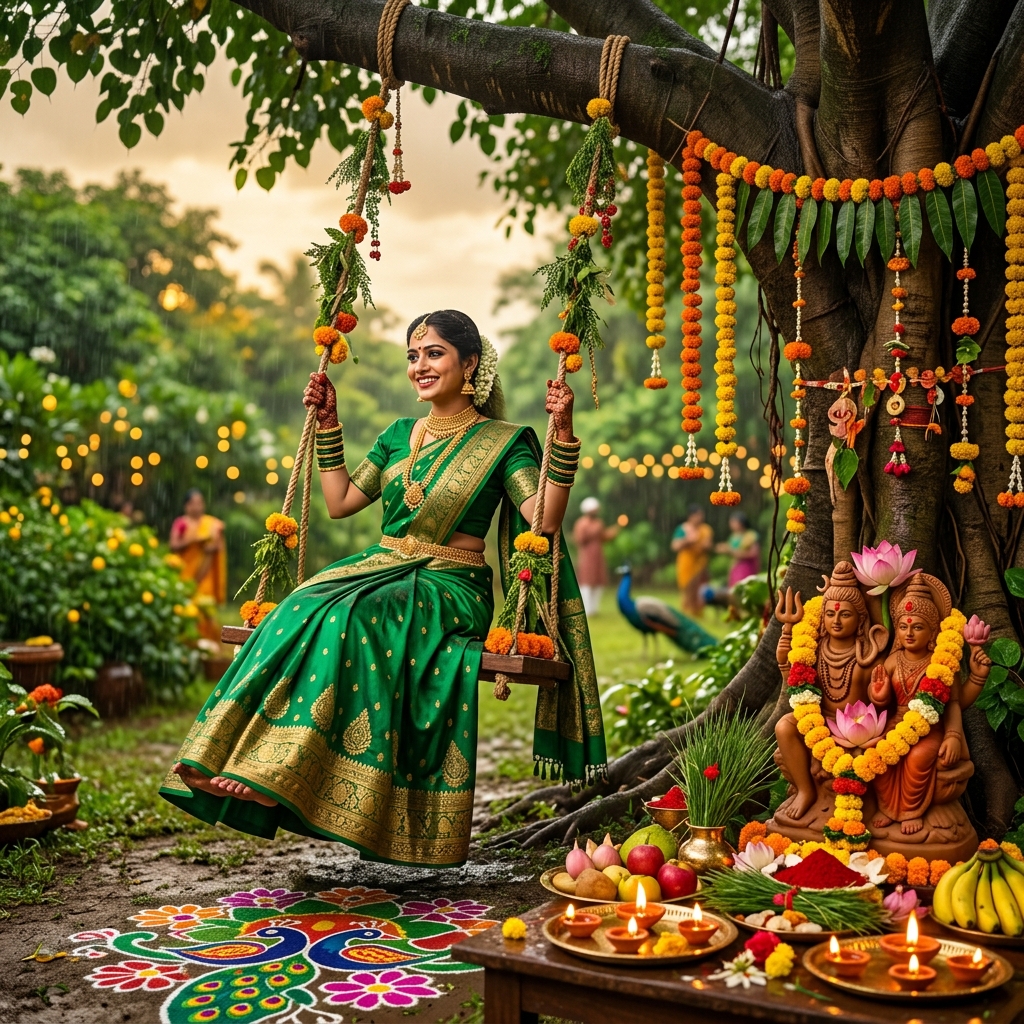
Hariyali Teej is one of the most beloved festivals of North India — celebrated on the third day (Tritiya) of the bright fortnight of Sravana by married women who fast and worship Goddess Parvati for the health, longevity, and prosperity of their husbands. In 2026, it falls on Saturday, August 15 — a doubly auspicious day as it also coincides with India's Independence Day. The auspicious puja muhurat is 06:00 AM to 08:30 AM IST.
Hariyali Teej 2026 — Exact Tithi & Muhurat
The Sravana Shukla Tritiya Tithi and the auspicious puja window (IST):
⭐ Why the Morning Muhurat Is Most Potent
On Hariyali Teej, Goddess Parvati is said to descend to Earth at Brahma Muhurat to receive the devotion of fasting women. The 06:00–08:30 AM IST window captures both Brahma Muhurat and the Pratah Kaal (morning period) — when Parvati's energy is most accessible. Completing the puja within this window is especially powerful for Nirjala (waterless) fastobservers, as the fast's merit multiplies when the Sankalpa and Gauri Puja are completed before consuming even water.
The Deep Significance of Hariyali Teej
Why Hariyali Teej is the most celebrated monsoon festival — mythological, astrological, and ecological dimensions.
Parvati's Reunion with Shiva
The mythological root of Hariyali Teej is the reunion of Goddess Parvati with Lord Shiva. After Parvati's intense tapas (austerities) lasting 107 lifetimes — including this life in which she was born as the daughter of King Himavat — Lord Shiva accepted her as his consort on the Sravana Shukla Tritiya day. This reunion is the most celebrated love story in Hindu mythology. Married women fast and worship Parvati-Shiva today to invoke the same devotion, permanence, and divine love in their own marriages.
Hariyali — The Monsoon Greenness
The word Hariyali means "greenness" or "lush vegetation." Hariyali Teej falls in the peak monsoon season when the earth is covered in vibrant green — new grass, fresh leaves, and the fragrance of wet earth (petrichor). The Sravana month is when Nature herself is at her most fertile and abundant. Wearing green (the definitive Teej colour), swinging on Jhulaas under rain-kissed trees, and decorating with green Durva grass — all celebrate the monsoon's life-giving abundance and Parvati's earth-mother aspect.
Astrological Significance
In Vedic astrology, the Sravana Shukla Tritiya is ruled by the Moon (Cancer's planet) in its most auspicious waxing phase — amplifying emotions, devotion, and abundance. The Tritiya tithi itself is associated with Gauri Puja and is one of the five most auspicious tithis in the Hindu calendar (Panchami, Tritiya, Ekadashi, Ashtami, Chaturdashi). Sravana is entirely ruled by Lord Vishnu — and Lakshmi-Parvati's combined energy is at its peak during this month. The Jhula (swing) ritual connects earth and sky energies in a sacred circuit.
Why We Celebrate Hariyali Teej — Its Deep Human Significance
From Parvati's 107 lifetimes of devotion to the Ghoomar dance under monsoon skies — Hariyali Teej is a masterclass in devotion, femininity, and cosmic love.
📖Parvati's 107 Lifetimes of Tapas — The Greatest Love Story
The Shiva Purana records how the goddess who would become Parvati performed intense austerities (Tapas) across 107 lifetimes to earn Lord Shiva as her husband. In her 108th life, born as Parvati to King Himavat and Queen Mena of the Himalayas, she undertook the most extreme tapas — standing on one leg in scorching heat, standing in icy water, and finally observing the Hariyali Teej Vraton Sravana Shukla Tritiya, offering her devotion entirely to Shiva. Moved by her absolute devotion, Lord Shiva accepted her as his divine consort. This is the origin of the Hariyali Teej Vrat — women re-enact Parvati's devotion to invoke the same divine love in their own marriages.
🎪Regional Celebrations — Rajasthan, UP, Haryana & Bihar
Hariyali Teej is most grandly celebrated across Rajasthan, Uttar Pradesh, Haryana, Bihar, Jharkhand, and Madhya Pradesh. In Rajasthan, the Teej festival is a royal occasion — the famous Teej procession (Teej Sawari) in Jaipur features Goddess Teej (Parvati) carried through the city on a palanquin decorated with marigolds, accompanied by folk musicians, dancers, camels, and elephants, drawing thousands of devotees. In UP and Bihar, women gather under trees to swing on decorated Jhulaas (swings), sing Teej folk songs (Kajri and Malhar), and apply Mehndi together — the Teej mehndi night (the evening before the festival) is a major social event.
🌺 Solah Shringaar — The 16 Adornments of a Teej Woman
On Hariyali Teej, every married woman is considered a manifestation of Goddess Parvati. The Solah Shringaar (16 adornments) she wears is both a devotional act and an assertion of auspicious femininity. Each adornment has a specific meaning in the cosmology of Parvati-Shiva worship. The most important on Hariyali Teej are: green glass bangles (Hariyali), fresh Mehndi on hands, Sindoor in the hair parting, green lehenga or saree, and fresh jasmine Gajra in the hair. Wearing these is considered an act of prayer — adorning oneself as Parvati adorned herself for Shiva.
Solah Shringaar — 16 Sacred Adornments of Hariyali Teej
Each adornment worn by women on Teej carries deep spiritual meaning as an offering to Goddess Parvati. Click to explore each.
Bindi
Spiritual Meaning: Third eye / Solar energyRed or maroon bindi — worn as the mark of Goddess Parvati's sindoor energy
7 Forms of Goddess Parvati Worshipped on Teej
Parvati manifests in 7 divine forms — each bestowing unique blessings on Hariyali Teej.
Uma
Aspect: Gentle graceThe peaceful, luminous form of Parvati as the devoted wife of Shiva. Uma represents ideal wifely virtue and grace — invoked for harmony in marriage.
Peace, serenity, gentle love in marriage
Step-by-Step Hariyali Teej Puja Vidhi
The core Gauri-Shiva Puja must be completed within the auspicious muhurat window (06:00–08:30 AM IST on August 15, 2026). Follow these sequential steps:
- 1
Mehndi Night — The Evening Before (Aug 14)
The eve of Hariyali Teej is Mehndi Night — women apply intricate henna patterns on their hands and feet. This is a festive social occasion where women gather to apply Mehndi together, sing Teej folk songs (Teej ke Geet, Kajri, and Malhar), and decorate the Jhula (swing). The Mehndi must be applied and allowed to dry completely overnight so it develops the deepest possible colour by morning.
- 2
Pre-Dawn Snanam & Sankalpa
Wake before sunrise. Take a purifying bath — traditionally with sesame oil (Til ka Tel) or in water with Haldi and Neem leaves. Wear new green attire (lehenga, saree, or salwar) and complete the Solah Shringaar (all 16 adornments). Apply fresh Sindoor and full jewelry. Sit facing east and take the Sankalpa: "I observe the Hariyali Teej Vrat for the long life, health, and prosperity of my husband. May Goddess Parvati and Lord Shiva bless our marriage with eternal love."
- 3
Gauri-Shiva Murti Sthapana
Place the clay Parvati (Gauri) and Shiva idol or image on a wooden plank covered with green leaves or new cloth. Decorate with fresh jasmine garlands, marigolds, Durva grass, and green Bilva (Bel Patra) leaves. Some families prepare the idol fresh from river clay on the morning of Teej — this hand-crafted idol is considered especially sacred for the Hariyali Teej Vrat.
- 4
Shodasopachara Gauri Puja — 16 Services
Offer the 16 services to Goddess Gauri (Parvati) and Lord Shiva: Asana (seat), Padyam (water for feet), Arghyam (water for hands), Snanam (milk bath), Vastram (green cloth), Abhushan (offering of Shringaar items — bangles, sindoor, bindi), Gandha (sandalwood), Pushpa (jasmine garlands), Dhupam (incense), Dipam (ghee lamp), Naivedyam (Ghevar, Kheer, and fruits), Tambulam (betel leaves), and Nirajana (camphor Aarti). Offer each item while chanting the corresponding mantra.
- 5
Teej Vrat Katha Shravan
Read or listen to the Hariyali Teej Vrat Katha — the story of Parvati's tapas and reunion with Shiva. This Katha is found in the Shiva Purana and Skanda Purana. Reading the Katha is considered mandatory for the Vrat to be fully effective. After the Katha, perform the Aarti of Parvati-Shiva while ringing the bell and singing the traditional Teej Aarti song.
- 6
Jhula (Swing) Ritual — The Heart of Hariyali Teej
After completing the puja, participate in the Jhula ritual — swing on a decorated swing while singing Teej folk songs. This is the most joyful and iconic element of Hariyali Teej. The Jhula symbolizes Parvati and Shiva swinging together in divine love and joy. Even if a physical swing is not available, singing the Jhula songs (especially Sawan ke Geet) while performing a symbolic swinging motion is sufficient. In many communities, women compete for the best Mehndi colour — darker Mehndi is considered a sign of deeper love.
- 7
Fast-Breaking (Parana) — After Moonrise
The Hariyali Teej fast is traditionally broken after sighting the moon at night or after performing the evening Aarti at sunset. Traditional Parana food includes Ghevar, Malpua, Kheer, Batasha, and seasonal fruits. Distribute Prasad generously to all household members and neighbours. The husband traditionally presents the wife with new bangles, Mehndi, Sindoor, and gifts (called Sindhara) on Hariyali Teej — a beautiful tradition of marital celebration.
Fasting Rules & Taboos
water_drop1. Nirjala or Phalahar Vrat
Most married women observe a full Nirjala fast (no water) or Phalahar fast (fruits and milk only) from sunrise until moonrise. The Nirjala Teej fast is considered the most meritorious — traditional belief holds that observing a strict Nirjala Teej fast for 16 consecutive years bestows a woman with the blessings of Parvati and prevents widowhood. The fast is broken only after sighting the moon or performing the evening puja.
celebration2. Sindhara — The Husband's Gift
On Hariyali Teej, it is traditional for the husband (and his family) to send Sindhara — a ceremonial gift tray — to the wife. Sindhara includes new green bangles, Mehndi (henna), Sindoor, green lehenga or saree, sweets (especially Ghevar), and jewelry. For newly married women (in their first year of marriage), the Sindhara from the husband's family is an especially important Teej tradition and is often sent with great fanfare.
grass3. Mandatory Green Colour
Wearing green is mandatory on Hariyali Teej — it is the festival's defining colour, representing the lush monsoon greenness (Hariyali). Green glass bangles are the most important adornment. The Durva grass (Doob) offered in the puja must also be fresh and green. Even the decorations for the Jhula (swing) must include green elements — fresh leaves, green ribbons, and mango leaf torans.
block4. Forbidden Activities
Avoid eating non-vegetarian food, onion, or garlic on Teej day. Do not sleep during the day on the festival (especially while fasting — Teej fast requires wakefulness and devotion throughout). Avoid dark or inauspicious colours like black or white for attire. Do not comb your hair or look in the mirror excessively during the puja hours. Avoid any arguments or harsh speech — the day must be filled with songs, joy, and devotion.
Hariyali Teej Puja Samagri Checklist
Collect these items by August 13–14 so your Mehndi Night preparations and morning puja are smooth and uninterrupted.
| Category | Required Items |
|---|---|
| Parvati-Shiva Idol | Clay or brass idol of Goddess Gauri (Parvati) and Lord Shiva together, OR a clay Parvati idol made from river clay (Nadi ki Mitti). In many traditions, the Teej idol of Parvati is made fresh on the morning of the festival — especially in Rajasthan and UP. |
| Flowers & Garlands | Fresh jasmine garlands (Mogra — mandatory), marigold garlands in saffron/orange, Durva grass (doob — especially important for Hariyali Teej), lotus flowers, banana leaves, Bel Patra (Bilva leaves for Lord Shiva), and fresh green grass or creepers. |
| Mehndi & Shringaar | Fresh henna (Mehndi) paste for hands — applied the evening before. Green glass bangles (Hariyali Teej's signature offering). Sindoor, kumkum, bindi, kajal, gajra (jasmine or marigold flowers for hair), and new green or red attire (Lehenga or Saree). |
| Puja Offerings | Turmeric (Haldi), kumkum, sandalwood paste, incense sticks (Chandan or jasmine fragrance), pure ghee lamp, camphor (Kapur), conch shell (Shankh), and a sacred thread (Mouli) in red and yellow. |
| Bhog & Naivedyam | Ghevar (the quintessential Teej sweet — a honey-combed flour cake soaked in sugar syrup and rabri), Kheer (rice pudding), Malpua, Baati Churma, seasonal fruits, coconut, and Panchamrit (milk, curd, honey, ghee, sugar). Ghevar is the definitive Teej sweet and should always be offered. |
| Jhula (Swing) Decoration | A wooden or decorated swing (Jhula) hung from a tree or installed indoors — decorated with marigold garlands, green mango leaves (Toran), colourful ribbons, and flower strings. The Jhula is the most iconic element of Hariyali Teej. Even a simple rope swing decorated with flowers is sufficient. |
| Donation Items | Bangles and sindoor for gifting to married women, green cloth or saree piece, Ghevar sweets for distribution to neighbours, and cash Dakshina for the performing priest or Brahmin family. |
Time Until Puja Muhurat Opens
Counting down to 06:00 AM IST, August 15, 2026 — the start of the auspicious Gauri-Shiva Puja window.
📋 Muhurat Summary — August 15, 2026
Zodiac-Wise Hariyali Teej Blessings & Remedies
Select your Rashi to get personalized Hariyali Teej blessings, the relevant Parvati form, and specific remedies for your zodiac sign.
Cancer — Karka (कर्क)
Ruling Planet: Moon (Chandra)Moon-ruled Cancer finds Hariyali Teej one of the most emotionally nourishing festivals of the year. Annapurna's blessings of home, food, and family prosperity flow most abundantly to Cancer natives who observe this Vrat.
Om Annapurnayai Namah
Chant 108 times during morning puja
Prepare all traditional Teej foods with love. Invite your mother or mother-in-law for Teej celebration. Offer rice, coconut, and white flowers to Parvati.
Powerful Hariyali Teej Mantras
These mantras invoke Goddess Parvati and Lord Shiva's blessings for eternal marital love and divine grace on Hariyali Teej.
Parvati Mantra — Invocation of Gauri
Om Gauryai Namah
Hrim Gauryai Namah
Sarva Mangala Mangalye
Shive Sarvaartha Sadhike
"Salutations to Gauri (Parvati). She who is the most auspicious of all auspicious things, the consort of Shiva, who fulfills all wishes — I bow to you."
The primary mantra for Hariyali Teej puja. Chant 108 times before beginning the Shodasopachara worship. Especially powerful for married women.
Parvati-Shiva Union Mantra
Om Gauri Shankarabhyam Namah
Ardhanarishwaraya Namah
Uma Maheshwaraya Namah
"Salutations to Gauri (Parvati) and Shankara (Shiva) together. Salutations to Ardhanarishwara (the half-male, half-female form). Salutations to Uma and Maheshwara."
Chant during the Jhula (swing) ritual while swinging. This mantra invokes the divine union of Parvati-Shiva and brings the same eternal love to the devotee's marriage.
Teej Vrat Sankalpa Mantra
Om Shree Parvati Devi Prasaadaat
Mama Pati Aayur Vardhanatve
Hariyali Teej Vrat Karishye
Iti Sankalpa
"By the grace of Goddess Parvati, for increasing my husband's lifespan and well-being, I take the solemn vow (Sankalpa) of Hariyali Teej Vrat."
Chant this Sankalpa mantra at the very beginning of the puja while holding a flower or water in cupped hands. This formally begins the Vrat and invokes divine witness.
Mahamrityunjaya for Husband's Longevity
Om Tryambakam Yajamahe
Sugandhim Pushtivardhanam
Urvaarukamiva Bandhanaat
Mrityor Mukshiya Maamritaat
"We worship the three-eyed Shiva, who is fragrant and nourishes all beings. May he liberate us from death as a cucumber from its vine, granting immortality."
Chanted by women on Hariyali Teej for the long life and good health of their husbands. Chant 11 or 108 times during the puja. One of the most powerful protective Shiva mantras.
Frequently Asked Questions — Hariyali Teej 2026
When is Hariyali Teej in 2026?expand_more
Hariyali Teej 2026 is on Saturday, August 15, 2026 — the third day (Tritiya) of the bright fortnight (Shukla Paksha) of the Sravana month. This date also coincides with India's Independence Day. The Tritiya Tithi begins at 06:52 AM on August 15 and ends at 09:23 AM on August 16. The auspicious puja muhurat is 06:00 AM to 08:30 AM IST on August 15.
What is the difference between Hariyali Teej, Kajari Teej, and Hartalika Teej?expand_more
There are three major Teej festivals: (1) Hariyali Teej (Sravana Shukla Tritiya — August 15, 2026) — the first Teej of the monsoon, celebrating Parvati's reunion with Shiva, observed primarily in North India. (2) Kajari Teej (Bhadra Krishna Tritiya) — celebrated 3 weeks later, associated with Goddess Kajali and the monsoon harvest. (3) Hartalika Teej (Bhadra Shukla Tritiya, near Ganesh Chaturthi) — the most important Teej, especially in Maharashtra, where clay idols of Parvati-Shiva are made and worshipped with a strict all-night vigil. Hariyali Teej is distinguished by its emphasis on greenness (Hariyali), the Jhula (swing) ritual, and the Sindhara tradition.
Can unmarried women observe Hariyali Teej?expand_more
Yes. Unmarried women can and do observe Hariyali Teej with the prayer to receive an ideal husband, just as Goddess Parvati fasted for Shiva. The Vrat for unmarried women focuses on prayers to Parvati for a loving, suitable husband and an auspicious marriage. The same puja vidhi is followed, with the Sankalpa adapted to reflect the intent of attracting a good marriage partner.
What is the significance of green colour on Hariyali Teej?expand_more
Green is the defining colour of Hariyali Teej and represents: (1) Hariyali — the lush monsoon greenness that the festival celebrates; (2) Fertility and abundance of the earth during the monsoon; (3) The sacred Durva grass offered to Parvati, which is bright green; (4) Parvati's nature aspect — she is the earth mother, and green is the colour of living earth. Green glass bangles are the most important adornment — wearing them signifies the observance of the Vrat and invites Parvati's blessings.
What is the Sindhara tradition on Hariyali Teej?expand_more
Sindhara (also called Sinjara or Satuda) is a beautiful tradition where the husband's family sends gifts to the married woman on the day before Hariyali Teej (August 14, 2026). The Sindhara tray includes: new green bangles, fresh Mehndi, Sindoor, green lehenga or saree, Ghevar and other sweets, seasonal fruits, and jewelry. For women in their first year of marriage (Nayee Naveli Dulhan), the Sindhara is especially elaborate. This tradition represents the husband's acknowledgment and celebration of his wife's devotion.
How long should the Hariyali Teej fast be observed?expand_more
The Hariyali Teej fast is traditionally observed from sunrise on August 15 until moonrise on the same evening. Strict observers perform a Nirjala fast (no food or water from sunrise to moonrise). The Phalahar option (fruits, milk, and dairy only) is also widely observed. Breaking the fast after sighting the moon is considered most auspicious. Traditional belief holds that observing a strict Nirjala Teej fast for 16 consecutive years grants Parvati's supreme blessings for the husband's health and longevity.
Is Hariyali Teej the same as Independence Day in 2026?expand_more
Yes — in 2026, Hariyali Teej and India's Independence Day (August 15) coincide, making August 15, 2026 a doubly significant and auspicious day. This is a rare and auspicious combination — the festival of Parvati's devotion and India's freedom coincide, infusing the celebration with patriotic and spiritual energy together. Many communities will combine the Independence Day flag hoisting in the morning with Hariyali Teej celebrations, swings, and Mehndi festivities.
Explore Other Sacred Pujas & Festivals
Continue your spiritual journey with detailed guides to other sacred observances in 2026.