
Mahalaya 2026 — Pitru Tarpan & Devi Paksha
The sacred threshold between the fortnight of the ancestors and the fortnight of the Goddess. Honour your Pitrus with Tarpan, witness the iconic Bengali Mahalaya dawn tradition, and welcome Maa Durga's descent on Saturday, October 10, 2026.
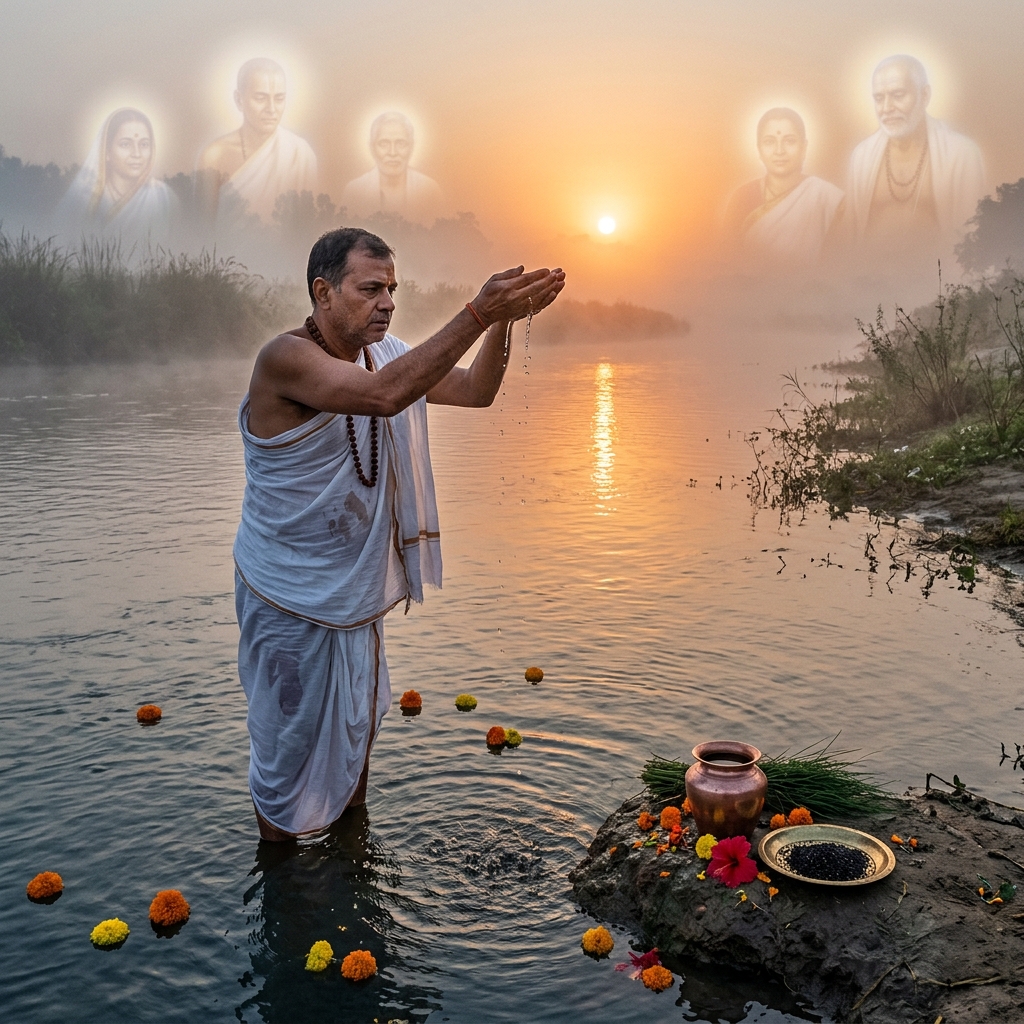
🌅 Pitru Tarpan at dawn — Ashwin Krishna Amavasya, October 10, 2026
The ancestors receive their final offering. The Goddess begins her descent.
What is Mahalaya?
Mahalaya is one of the most profound days in the Hindu calendar — a day that sits precisely at the intersection of two sacred fortnights. It falls on Ashwin Krishna Amavasya (the no-moon night of the Ashwin lunar month), marking the final day of Pitru Paksha (the 15-day period of ancestral remembrance) and simultaneously the dawn of Devi Paksha (the 15-day sacred fortnight of the Goddess, which includes Navratri and Dussehra).
On this day, Hindu tradition holds that the gates between the ancestral realm (Pitru Loka) and the earthly plane are at their widest open. Departed souls — parents, grandparents, and ancestors across generations — are believed to be closest to the living. The primary ritual is Pitru Tarpan: the offering of water (mixed with black sesame and sacred grass) to nourish and release the souls of the departed. By completing these offerings on Mahalaya, we both honour our ancestors and clear the karmic channel between generations.
From the cosmic perspective, Mahalaya represents a powerful sandhikala (sacred transition). The Sun and Moon are aligned at the Amavasya, amplifying the potency of any ritual performed. Ancient texts like the Garuda Purana, Manusmriti, and Skanda Purana all prescribe this specific Amavasya as the most efficacious day for ancestral rites in the entire year.
For Bengalis, Mahalaya is Everything
While Mahalaya is observed across India, no community feels it quite as deeply as Bengali Hindus. For them, it is not merely a religious observance — it is the emotional beginning of the year's most joyful and sacred festival: Durga Puja. Every sight, sound, and scent of Mahalaya morning is burned into Bengali cultural memory with a permanence that transcends generations and geographies.
Mahishasura Mardini — The 4 AM Radio Ritual
Every year at exactly 4:00 AM on Mahalaya morning, All India Radio (AIR Kolkata) broadcasts "Mahishasura Mardini" — a 90-minute programme of Sanskrit devotional verses (Chandipath), classical songs, and dramatic narration that has been playing since 1931. For Bengalis, hearing this broadcast is as sacred as any puja. Millions set alarms specifically to wake up in the pre-dawn darkness and listen, whether in Kolkata, Delhi, London, or New York.
“আশ্বিনের শারদপ্রাতে বেজে উঠেছে আলোর বেণু — তাই আমরা জেগে উঠি পুজোর আনন্দে।”
— Opening lines of Mahishasura Mardini, Birendra Krishna Bhadra (1905–1991)
“In the Ashwin morning of Sharad, the flute of light plays — and so we awake in the joy of Puja.”
⏰ Pitru Tarpan Muhurat for Mahalaya 2026
The most auspicious window for Tarpan on Mahalaya. Aligns with the Amavasya peak energy.
Secondary window. Equally valid. Suitable if the morning window is missed.
The entire pre-noon period is acceptable. Earlier is more auspicious. Never after sunset.
📿 Step-by-Step Pitru Tarpan Vidhi
Purification — Bath Before Sunrise
Wake before sunrise (ideally by 5:30 AM IST on Oct 10). Take a bath with clean water — traditionally in a holy river (Ganga, Yamuna, Godavari). If at home, add a few drops of Gangajal to your bath water. Wear clean, white or light-coloured clothes. Remove footwear throughout the ritual.
Facing South — The Direction of Pitrus
Pitru Tarpan is always performed facing South — the direction of Yama (Lord of Death and Dharma), who governs the realm of the departed. Stand facing south, near a body of water (river, lake, or a vessel of water placed on the ground). Place a brass or copper vessel (lota) filled with clean water to your right.
Sankalpa — Sacred Declaration
Hold water, black sesame seeds (kala til), darbha (kusha) grass, and a white flower in your cupped hands. Recite the Sankalpa: state your name, gotra (ancestral lineage), and the purpose — offering Tarpan to Pitrus on Ashwin Krishna Amavasya 2026. This declares your intent to the universe.
Tarpan — The Water Offering
Pour water through your right hand in a thin stream (from between the thumb and index finger) while chanting each ancestor's name. Perform three rounds of water-offering per ancestor — for father, paternal grandfather, paternal great-grandfather, mother, maternal grandparents. Add kala til (black sesame) to each offering — sesame is the most sacred grain for ancestral rites.
Pind Daan (Optional but Auspicious)
At major pilgrimage rivers (Gaya, Prayagraj, Haridwar, Kolkata Babughat), priests assist in Pind Daan — offering rice and barley flour balls (pind) to departed ancestors. If you cannot travel, offering cooked rice mixed with til, ghee, and honey on a banana leaf in the south-facing direction at home serves as an equivalent.
Brahmin Bhojan — Feeding the Learned
After Tarpan, invite Brahmins or worthy elderly persons for a meal. This act of feeding humans who embody dharmic knowledge is believed to directly nourish the departed souls in the ancestral realm. If no Brahmin is available, feed any elderly, poor, or needy person. Offer food, cloth (daan vastra), and dakshina.
Cow & Crow Feeding
Ancestors are believed to arrive in the form of crows during Pitru Paksha. Offer rice balls (pind) or balls of cooked rice mixed with ghee and sesame to crows on your rooftop or in an open area. If a crow accepts the offering, it is a highly auspicious sign that your ancestors have received your Tarpan.
🛍️ Mahalaya Tarpan Samagri Checklist
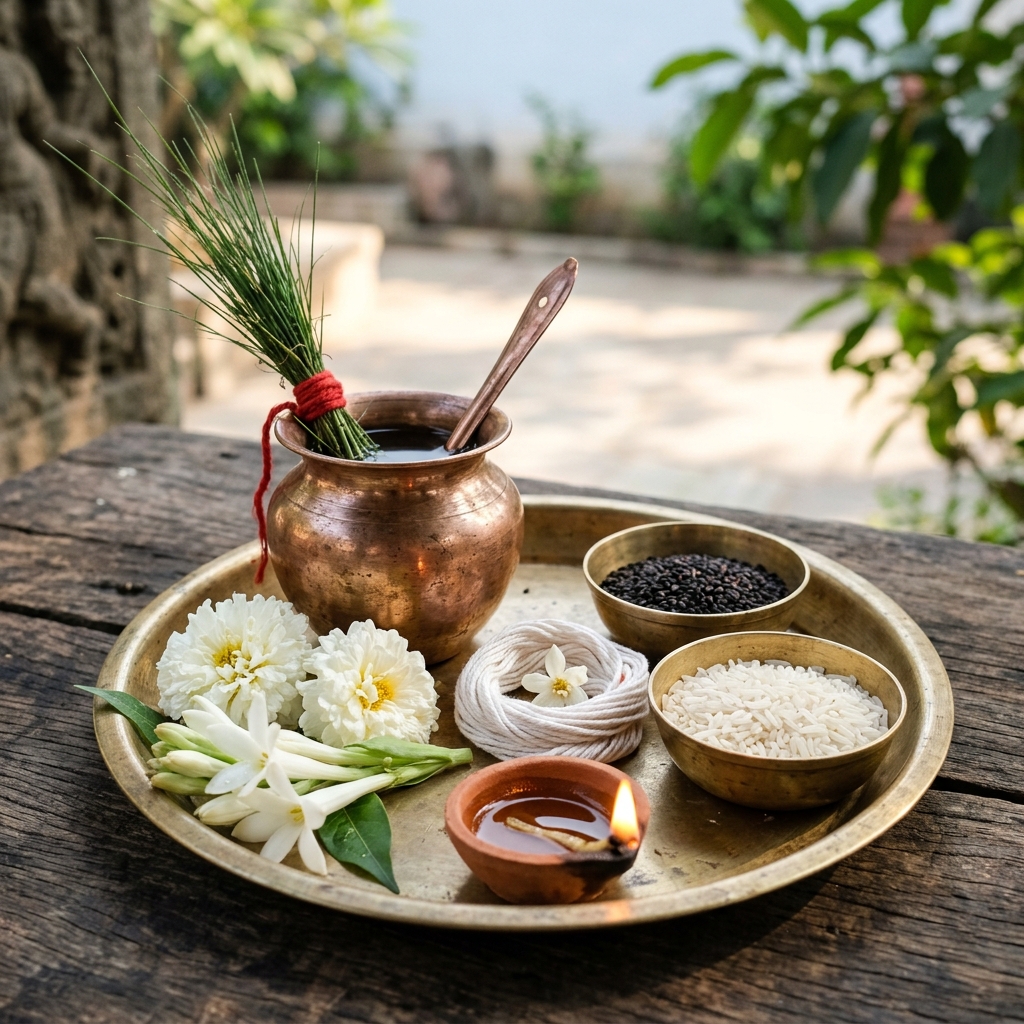
Gather these items the evening before Mahalaya (October 9) so you are ready for the pre-dawn ritual on October 10.
🕉️ Pitru Tarpan Mantras
[Ancestor's Name] sharma/varma/dasa [gotra] gotrasya pitṛe svadhā namaḥ Oṃ pitṛbhyaḥ svadhā namaḥ, pitāmahebhyaḥ svadhā namaḥ Prapitāmahebhyaḥ svadhā namaḥ
Offered during Tarpan. Insert the ancestor's name and gotra. Svadhā is the sacred word specific to Pitru rituals (different from Svāhā used in fire rituals). Pour water from right hand while chanting.
उदीरतामवर उत परास उन्मध्यमाः पितरः सोम्यासः। असुं य ईयुरवृका ऋतज्ञास् ते नो'वन्तु पितरो हवेषु॥
"May the lower, upper, and middle ancestors — the gentle, soma-drinking, truth-knowing departed souls — who have gone to the other world, help us in our invocations." — Rigveda 10.15.1
ॐ तत्सत् अद्य अश्विन मास कृष्ण पक्षे अमावस्यायां तिथौ — अस्माकं पितृणां तृप्त्यर्थं तर्पणं करिष्ये
"On this Ashwin Krishna Amavasya Tithi, I perform Tarpan for the satisfaction of my ancestors." Replace with your specific date/name during the Sankalpa. This declaration formalises the ritual.
ॐ पितृ देवाय विद्महे जगत् धारिणी धीमहि तन्नो पितृ प्रचोदयात्
The Pitru Gayatri Mantra. Chant 108 times on Mahalaya for peace of departed ancestors and for healing ancestral karma across generations. Particularly powerful if recited facing south during sunrise.
♈ Mahalaya Ancestral Remedies by Rashi
Mahalaya Tarpan dissolves accumulated ancestral karma (Pitru Dosha). Select your Moon sign to see the specific remedy that amplifies this effect for your chart in 2026.
❓ Frequently Asked Questions
Mahalaya 2026 falls on Saturday, October 10, 2026. It is Ashwin Krishna Amavasya — the no-moon day that ends Pitru Paksha (the fortnight of ancestral remembrance) and begins Devi Paksha (the sacred fortnight of the Goddess). The Amavasya Tithi begins at 05:12 AM on October 10 and ends at 06:21 AM on October 11.
"Mahalaya" is a Sanskrit compound: Maha (महा — great) + Alaya (आलय — abode/dwelling). It refers to the "great abode" — the period when the realms of the ancestors (Pitru Loka) and the divine (Devi Loka) are said to be most accessible from the earthly plane. Some interpret it as the great gathering or great dissolution — the point where Pitru Paksha dissolves into Devi Paksha.
Since 1931, All India Radio (AIR Kolkata) has broadcast "Mahishasura Mardini" at exactly 4:00 AM on Mahalaya morning. This 90-minute programme — featuring the legendary voice of Birendra Krishna Bhadra reciting Sanskrit Chandipath along with devotional compositions by Pankaj Kumar Mullick — is a non-negotiable ritual for Bengali Hindus worldwide. The broadcast announces that Maa Durga has begun her descent from Kailash, and hearing it in the pre-dawn darkness is considered deeply auspicious.
Traditionally the eldest son performs Tarpan for paternal ancestors. In the absence of a son, daughters, grandsons, nephews, or any close relative may perform it. Women may offer Tarpan for their own parents and in-laws. Non-Hindus or those without family guidance can offer three handfuls of water facing south with the Pitru Suktam — the sincere intention matters most.
Mahalaya (Oct 10) is the last day of Pitru Paksha — a 15-day period of honouring departed ancestors through fasting, Tarpan (water offerings), and charity. The very next day, Sharad Navratri begins (Oct 11) — nine nights of worshipping the nine forms of Goddess Durga. Mahalaya is the sacred hinge: the ancestors are honoured and released, and the Goddess descends.
Pitru Tarpan is a Vedic practice rooted in the belief of ancestral consciousness and karmic lineage. While it is primarily a Hindu tradition, anyone who wishes to honour their departed loved ones, express gratitude to their ancestors, and seek their blessings may adapt its core practice — offering water, flowers, and an intention of love and gratitude, facing south at sunrise.
Black sesame (kala til) is the most sacred grain in Pitru rituals according to the Garuda Purana and Manusmriti. It is believed to have the highest potency in reaching ancestral souls because of its dark, absorptive quality. Sesame is associated with Saturn (Shani) and the south direction — both connected to the realm of the dead. Tarpan offered with kala til is said to satisfy ancestors for an entire year.