
The Dual Cosmic Victory: Lord Rama & Goddess Durga
Vijayadashami (the Tenth Day of Victory), also universally known as Dussehra, is one of the most auspicious dates in the Hindu lunar calendar. It represents the eternal triumph of Dharma (righteousness) over Adharma (unrighteousness). The day carries a dual spiritual significance:
- Triumph of Lord Rama: On this day, Lord Shri Rama, with the assistance of Sugriva's monkey army (Vanara Sena) and Lord Hanuman, vanquished the ten-headed demon king Ravana in Lanka, rescuing Maa Sita and establishing Ramrajya.
- Triumph of Goddess Durga: On the exact same day, after nine nights of intense battle, Goddess Durga slew the shape-shifting buffalo demon Mahishasura, earning the epithet Mahishasuramardini and restoring peace to the three worlds.
How Dussehra & Vijayadashami Are Celebrated Across India
Few festivals in the world display the astonishing cultural diversity of India as dramatically as Vijayadashami:
🔥North India: Ramlila Climax & Ravana Dahan
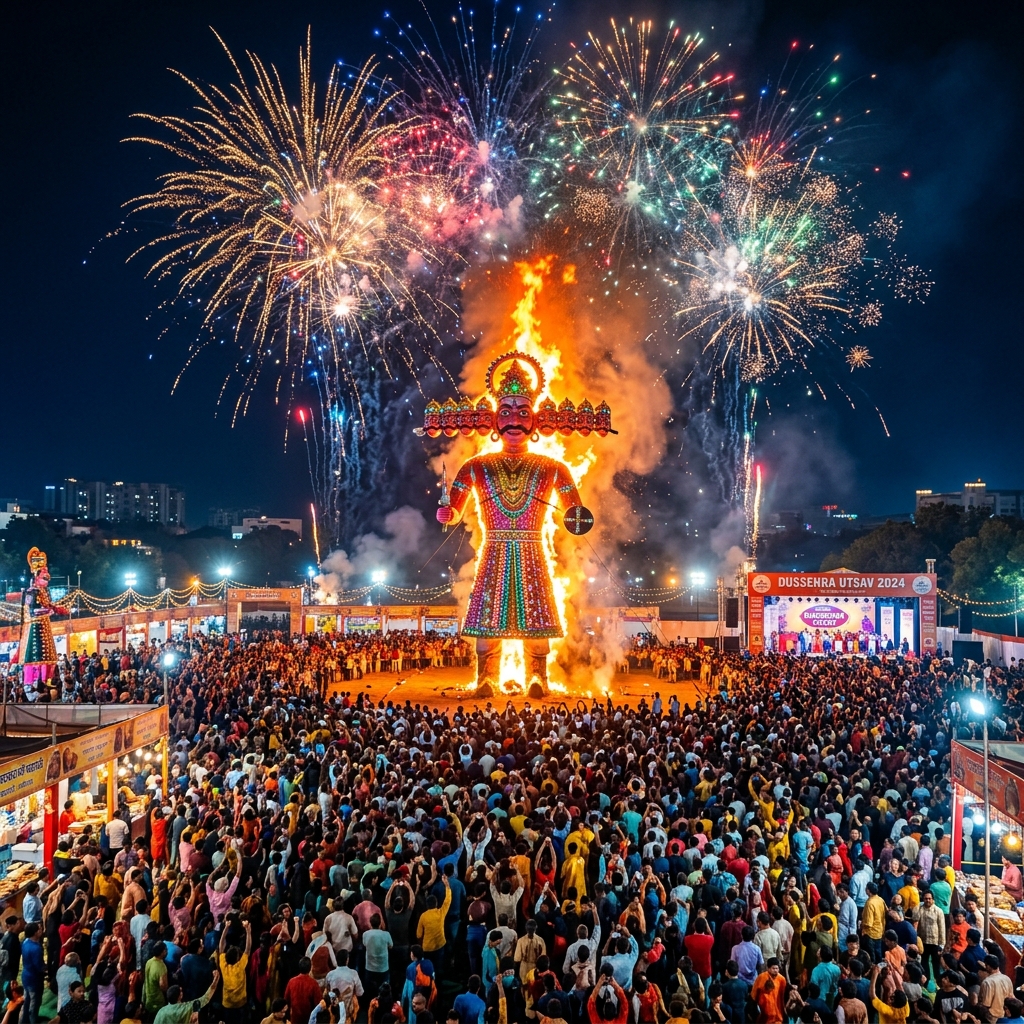
In Delhi, Uttar Pradesh, Punjab, Bihar, Rajasthan, and Madhya Pradesh, ten days of open-air Ramlila theatrical performances culminate on Dussehra evening. Massive grounds (Ramlila Maidans) host giant effigies of Ravana, Kumbhakarna, and Meghnada — often reaching 80 to 100 feet in height. As twilight falls, actors portraying Lord Rama shoot flaming arrows into the effigies, triggering spectacular fireworks displays amidst chants of "Jai Shree Ram!"
🐘 Karnataka: Mysuru Dasara Jamboo Savari
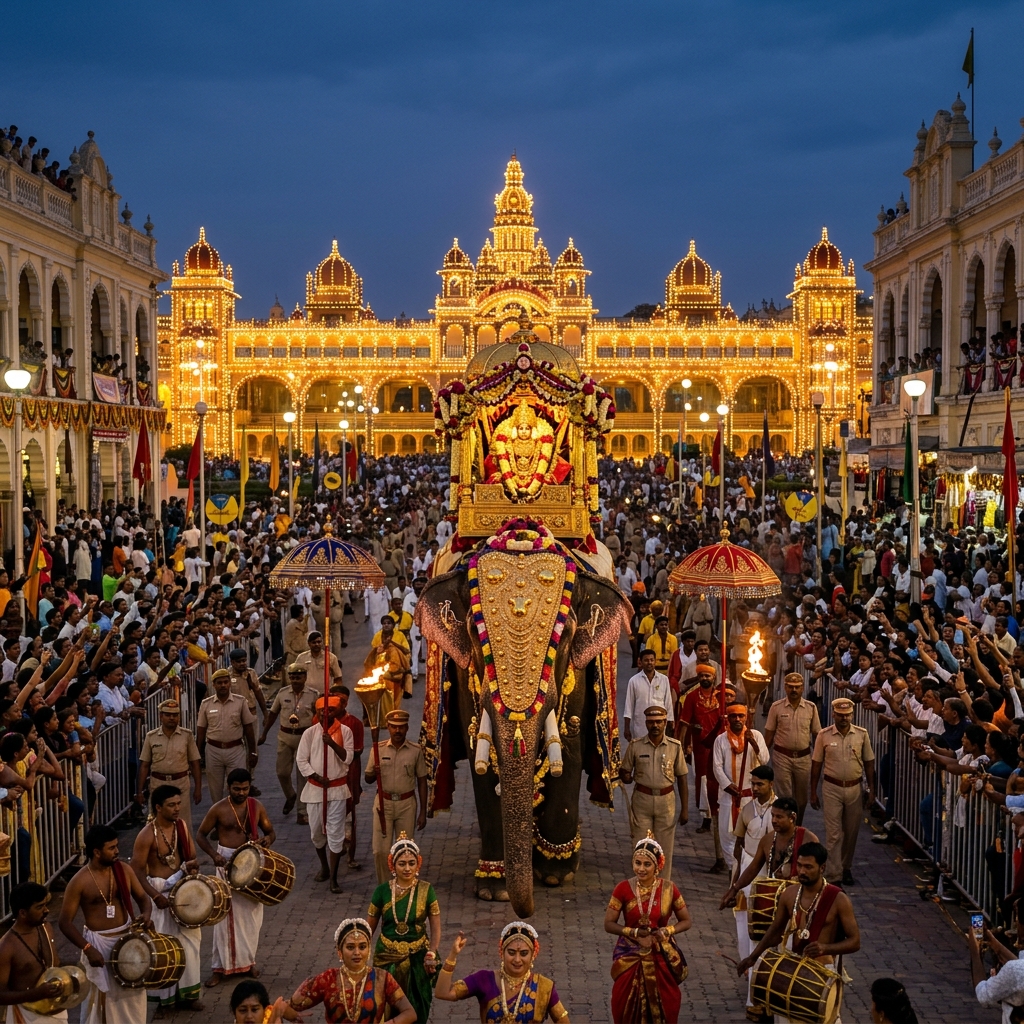
In Karnataka, Mysuru Dasara is celebrated with royal splendor. The 14th-century Vijayanagara tradition, continued by the Wadiyar dynasty, reaches its peak on Vijayadashami. A grand procession called Jamboo Savari winds through the streets of Mysuru, led by a decorated royal elephant carrying a 750 kg solid-gold howdah holding the idol of Goddess Chamundeshwari. At night, the magnificent Mysuru Palace lights up with nearly 100,000 light bulbs.
🔴West Bengal & East: Sindoor Khela & Durga Visarjan
For Bengali, Assamese, and Odia communities, Vijayadashami is a bittersweet day of farewell (Bishorjon). Married women dress in traditional white saris with red borders (Garad/Tussar) and perform Sindoor Khela — smearing vermilion on Goddess Durga's idol and on each other's faces, wishing marital bliss. Clay idols are immersed in rivers like the Ganga. The day ends with Bijoya Dashami greetings, touching elders' feet, and distributing Narkel Naru (coconut laddoos) and Nimki.
📖 Kerala: Vidyarambham (Ezhuthiniruthu)
In Kerala, Vijayadashami is dedicated to Vidyarambham — the sacred initiation of children into the world of learning. Toddlers aged 2–3 sit on the lap of an elder, guru, or scholar, who holds their index finger to write "Hari Sri Ganapataye Namah" on a tray of raw rice or sand, and touches a gold ring to the child's tongue. Thousands gather at famous temples like Panachikkadu Saraswathi Temple and Chottanikkara.
🏔️ Himachal Pradesh: Kullu Dussehra
Unlike the rest of India where Dussehra ends on Dashami, in the Kullu Valley of Himachal Pradesh, Kullu Dussehra begins on Vijayadashami and lasts for seven days. Over 200 local village deities (Mohras) mounted on wooden palanquins arrive at the Dhalpur maidan in Kullu to pay homage to Lord Raghunath (Lord Rama). No effigies are burned; instead, a sacred wooden sacrifice (Lanka Dahan) takes place on the Beas riverbank.
🌿Maharashtra & Gujarat: Shami Puja & "Sona" Exchange
In Maharashtra and Gujarat, people perform Shami Puja and Simollanghan (symbolically crossing borders for victory). People exchange leaves of the Bahi/Apta tree, treating them as gold ("Sona"), and greet each other with "Sona Ghyan, Sona Vha" (Take gold, be like gold). It commemorates Maratha warriors departing for military campaigns after seeking blessings on Vijayadashami.
Shami Tree Worship Vidhi & Sacred Stotram
Worshipping the Shami tree on Vijayadashami during Vijay Muhurat removes Saturn (Shani) doshas, protects against court cases, and ensures victory in all endeavors:
शमी शमयते पापम् शमी लोहितकण्टका।
धारिण्यर्जुनबाणानाम् रामस्य प्रियवादिनी॥
करिष्यमाणयात्राया यथाकालम् सुखम् मया।
तत्र निर्विघ्नकर्त्री त्वम् भव श्रीरामपूजिते॥
"O Shami tree, remover of sins, possessor of reddish thorns, protector of Arjuna's arrows during Agyatvas, and beloved of Lord Rama! As I embark on my journey of life and career, grant me victory and remove all obstacles."