
Jagannath Rath Yatra 2026
A grand celebration of divine accessibility, cosmic journeys, and planetary alignments. Explore the exact dates, procession details, and the rare Karka Sankranti astrological alignment that elevates this year's Rath Yatra.
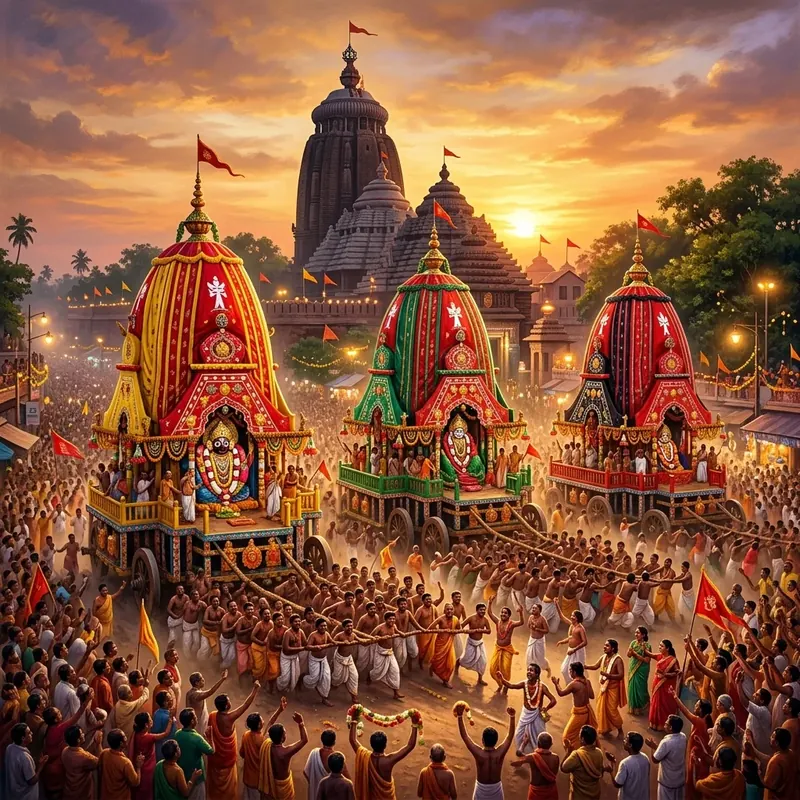
The Chariot Festival of the Lord of the Universe
The Descent of the Divine to the Streets
The historic Jagannath Rath Yatra (also known as the Chariot Festival) is one of the oldest and grandest religious processions in the world. It marks the annual journey of Lord Jagannath (a localized form of Lord Vishnu/Krishna), his older brother Lord Balabhadra, and his sister Devi Subhadra from their primary residence, the Shree Jagannath Temple in Puri, to the Gundicha Temple (the home of their maternal aunt).
Mythologically, the Gundicha Temple represents the home where the deities were originally crafted, making the Yatra a return to their origins. Unlike other temples where entry is restricted, Lord Jagannath breaks all boundaries of caste, creed, and religion by stepping out on the streets. This reflects the philosophy of absolute divine accessibility—anyone who sees the Lord on the chariot is blessed with spiritual cleansing.
Moksha and Salvation
"Rathe tu vamanam drstva punarjanma na vidyate" — Catching a glimpse of Lord Jagannath in His divine Vamana form on the chariot frees the soul from the cycle of rebirth.
Why We Celebrate Jagannath Rath Yatra & Its Deep Human Significance
The Rath Yatra is a grand symbol of divine accessibility, representing the descent of the supreme Lord of the Universe to walk among His creation.
📖 Mythological Origins: King Indradyumna & the Unfinished Idols
According to the Skanda Purana, the King of Malwa, King Indradyumna, wished to build a grand temple for Lord Vishnu. The celestial architect Vishwakarmaagreed to carve the idols from a sacred wooden log (Daru) under one condition: he must not be disturbed until the work was complete. However, the impatient queen opened the door early, causing Vishwakarma to vanish instantly, leaving the wooden idols of Jagannath, Balabhadra, and Subhadra with incomplete limbs. The Lord appeared in the King's dream, stating that He wished to reside in this very form to show that physical perfection is not required for divine connection.
🤝 Democratic Divinity: Breaking Caste and Religious Boundaries
Historically in India, temple entry was restricted for certain castes and non-Hindus. The Rath Yatra is revolutionary because **Lord Jagannath steps outside the sanctum sanctorum** to meet all devotees directly on the streets. Regardless of background, caste, creed, or faith, anyone can touch the ropes, pull the chariot, and catch a glimpse (Darshan) of the Lord. It stands as a powerful symbol of spiritual equality, affirming that the Divine belongs to everyone, especially the marginalized and excluded.
🔄 The Spiritual Metaphor of the Chariot
In the Katha Upanishad, the human body is compared to a chariot, the intellect to the charioteer, the mind to the reins, and the senses to the horses. Pulling the massive wooden chariots of Lord Jagannath represents **the surrender of one's mind and life journey to the divine will**. Devotees believe that pulling the chariot cleanses lifetimes of negative karma, guiding the soul back to its original spiritual home (Gundicha Temple, representing the origin of creation).
flagWhy Eastern India is the Epicenter
While Lord Vishnu is worshipped across India, the Jagannath cult is uniquely central to Eastern India (Odisha, Bengal, Assam, and Manipur). During the Ganga Dynasty (12th century), the rulers declared Lord Jagannath as the Rashtra Devata (State Deity) and ruled the kingdom as his vassals (Rutas). This tied the region's geopolitical, social, and spiritual identity directly to the deity.
In the 16th century, the great saint Chaitanya Mahaprabhu spent his final 18 years in Puri. His ecstatic singing and dancing (Sankirtan) popularized devotion to Lord Jagannath throughout Bengal and neighboring states, making the Rath Yatra a household event in almost every village in Bengal.
groupsIndigenous & Tribal Fusion
Unlike other mainstream Hindu deities, Lord Jagannath’s origins are not purely Vedic; they are deeply tribal. According to legends, he was originally worshipped as Nilamadhav by Viswavasu, a chief of the Savara tribe.
The modern Jagannath worship is a rare, organic synthesis of tribal rites and orthodox Vedic traditions. The deities are made of neem wood (Daru) rather than stone or metal, representing the forest-dwelling heritage. This roots the festival deeply in the tribal and indigenous consciousness of Eastern India, making it a democratic, community-owned celebration.
Beyond Puri: The Celebrations Across Odisha's Districts
While the grand temple town of Puri remains the heart of the festival, the Rath Yatra is celebrated with equal fervor in all 30 districts of Odisha. Each region has evolved its own unique tradition, known as local Srikhetras:
Known as the second Srikhetra, Baripada is famous for its unique custom established in 1975: the chariot of Devi Subhadra (Darpadaliana) is pulled exclusively by women. This tradition draws thousands of female devotees from across the country to participate in the sacred act of pulling the sister deity's chariot.
The Sri Baladevjew Temple in Keonjhar holds a Guinness World Record for the tallest wooden chariot in the world. Standing at over 72 feet, the massive chariot of Lord Balabhadra is built annually using ancient timber-joining techniques, a testament to Odisha's rural engineering skills.
Reflecting the tribal origin of the deities, the Sabara Srikhetra in Koraput celebrates the Rath Yatra with deep tribal participation. Before the chariots are pulled, local tribal chiefs perform rituals alongside priests, breaking all caste barriers and honoring the legendary tribal chief Viswavasu.
Kendrapara is home to the massive Brahma Taladhwaja chariot of Lord Baladevjew, which is one of the largest in Odisha. Pulling this giant chariot along the broad lanes of Kendrapara represents one of the largest regional gathering outside of Puri.
In historic royal states like Ranpur in Nayagarh and Banapur in Khurda, the local Rath Yatra is performed with active royal participation. The descendants of the local royal families perform the sweeping rituals, preserving the authentic royal heritage of the Ganga kings.
In these urban centers, hundreds of community chariots are pulled through the neighborhoods. Local streets are decorated with colored powders (Alpana/Jhoti), and traditional snacks like Arisha Pitha and Kakara Pitha are prepared in every home for distribution.
Procession Timings & Muhurta Details
The Rath Yatra is observed on the Dwitiya Tithi of the Shukla Paksha in Ashadha. Below are the key astronomical timings and dates to observe:
infoThe Phase of Pahandi Bije and Chariot Pulling
On the morning of July 16, 2026, the grand Pahandi rituals will begin, during which the heavy wooden deities are carried out of the temple by the priests in a rhythmic sway. The king of Puri then performs the Chhera Pahanra (sweeping of the chariot platforms with a gold broom). Chariot pulling starts only in the afternoon once the rituals are complete. Devotees are encouraged to follow live feeds from the Shree Jagannath Temple Administration (SJTA) for exact minute-by-minute updates.
The Astrological Core of Rath Yatra
Discover how the celestial alignment of 2026 channels unique spiritual and energetic vibrations to the Earth during the Yatra.
Karka Sankranti & Dakshinayana
In 2026, the Rath Yatra coincides precisely with Karka Sankranti on July 16, the day when the Sun transitions into Cancer. This marks the beginning of Dakshinayana, the six-month southern transit of the Sun, traditionally viewed as the "nighttime of the gods." This celestial shift redirects cosmic energy away from busy external pursuits and toward introspection, devotion, charity, and deep soul healing.
Overcoming the Malefics of Nabagraha
According to Vedic scriptures, during the Rath Yatra, the deities manifest themselves fully to clear the collective karma of their observers. Astrologers highlight that catching sight of Lord Jagannath on his chariot neutralizes the negative or malefic effects of all nine planets (Nabagraha) in a native's horoscope. The chariot's movement acts as a clearing mechanism for planetary delays.
The Three Gunas of Consciousness
Vedic astrology aligns the three siblings with the primary qualities of nature: Lord Jagannath represents Sattva (purity and truth), Lord Balabhadra represents Rajas (dynamism and motion), and Devi Subhadra represents Tamas (rest and grounding). Witnessing their unified movement on the chariots harmonizes these three gunas within the devotee's mind and astral body.
Rashi-Based Rath Yatra Guidance
Select your Moon Sign (Rashi) to discover customized remedies, auspicious attire colors, and a personalized Vishnu/Jagannath mantra to chant on the day of the Rath Yatra.
Mesh (मेष)
Channels Martian energy into spiritual protection, dispelling anger and clearing obstacles in pending work.
Donate red lentils (masoor dal) or wheat grains on Rath Yatra day.
"Om Namo Bhagavate Vasudevaya"
Translation: Salutations to the Supreme Lord who dwells in all beings.
The Sacred Chariots of Puri
Each year, the three chariots of Lord Jagannath, Lord Balabhadra, and Devi Subhadra are newly constructed from special neem wood. They possess specific color combinations, dimensions, and structural details that correspond to planetary configurations:
| Chariot Detail | Nandighosa (Jagannath) | Taladhwaja (Balabhadra) | Darpadaliana (Subhadra) |
|---|---|---|---|
| Chariot Color | Yellow & Red | Green & Red | Black & Red |
| Number of Wheels | 16 Wheels | 14 Wheels | 12 Wheels |
| Height | 45 Feet | 44 Feet | 43 Feet |
| Chariot Guardian | Garuda | Vasuki | Jayadurga |
| Presiding Horses | Shankha, Balahaka, Shweta, Haridashwa | Teevra, Ghora, Deerghashrama, Swarnanabha | Rochika, Mochika, Jita, Aparajita |
Global Accomplishments & Legacy
The Puri Rath Yatra is not just a regional festival—it is a monumental event with significant global milestones and historical footprints.
The "Juggernaut" Origin
The English word "juggernaut" (meaning an unstoppable, massive force) was coined directly by British observers who witnessed the Rath Yatra. They were awed by the sheer size of the chariots and the unstoppable momentum of millions of devotees pulling them down the Grand Road.
Heritage Chariot Engineering
Each year, the three giant chariots are built entirely from scratch by hereditary carpenters (Maharanas) using ancient measurements. They do not use blueprints, metal nails, or structural calculations, relying purely on memory, hand tools, and natural wooden joints—an engineering marvel preserved for centuries.
Global Expansion (100+ Cities)
In 1967, the founder of ISKCON, Srila Prabhupada, organized the first Rath Yatra outside India in San Francisco. Today, the festival is celebrated annually on major global avenues, including Trafalgar Square in London, Fifth Avenue in New York, Paris, Moscow, Sydney, and Toronto, demonstrating a massive globalization of Eastern Indian spiritual traditions.
The Mahaprasad: Sacred Nourishment
The food cooked in the temple of Jagannath is known as Mahaprasad. Prepared in earthen pots placed on top of each other using only firewood and charcoal, the cooking process is deeply symbolic. There are 56 varieties of cooked and uncooked food (Chhappan Bhog) offered to the deities daily.
During the Yatra, traditional sweets like Chhena Poda (baked cottage cheese sweet), Rasgulla, and dry sweets are distributed to devotees. Accepting Mahaprasad on this day is believed to absorb the positive vibrational energy of Lord Jagannath, supporting health and longevity.